Research Work
PULSATION
Ongoing
PULSes of ElephAnT carRION
Influence of pulses of mega-carcasses on predator-prey interactions and food webs of large mammals in African savannah.
PhD Thesis
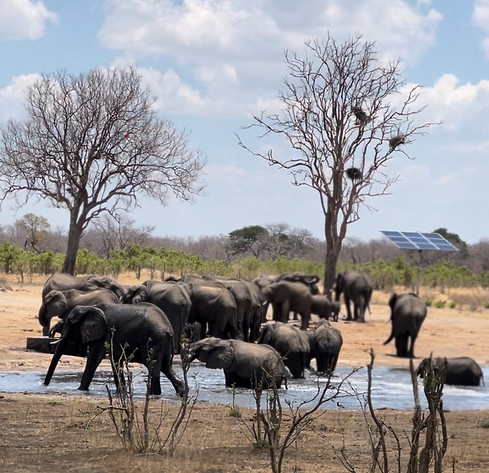
This doctoral research investigates how seasonal elephant carcass pulses influence the spatial and foraging behaviour of obligate and facultative scavengers in Hwange National Park, Zimbabwe. Elephant carcasses represent massive, pulsed resources that can fundamentally alter community dynamics across multiple trophic levels, yet scavenging remains understudied compared to predation in intact predator-scavenger systems. Hwange National Park, hosting ~ 65,000 elephants regulated through density-dependence and experiencing increasing severe droughts, provides an ideal natural environment with diverse scavenger communities including white-backed vultures, lappet-faced vultures, lions, and spotted hyenas.
Using a multi-scale approach combining GPS tags on vultures (White-backed vulture, Lappet-faced vulture), with GPS collars embedded accelero-magnetometer loggers on lions (Panthera leo) and spotted hyaena (Crocuta crocuta) individuals, systematic camera trapping elephant carcasses, and spatial analysis over four years, this study addresses five key research questions:
-
Characterising spatiotemporal properties of elephant carcass pulses,
-
Investigating public information use in scavenger detection and arrival sequences,
-
Analysing competitive dynamics and access patterns at mega-carcasses,
-
Examining impacts on facultative scavenger hunting behaviour and space use,
-
Assessing obligate scavenger foraging strategy shifts during resource pulses.
Expected outcomes include advancing optimal foraging theory in pulsed resource contexts, revealing information transfer mechanisms in scavenger guilds, and informing wildlife management strategies for ecosystem conservation. This research will provide insights into how mega-carcass pulses structure communities, promote species coexistence, and maintain ecosystem functioning in variable environments, with broader implications for understanding resource pulse ecology and guiding conservation efforts in systems where megafauna used to exist.




Mega-carcasses Project
Completed 2024
The role of mega-carcasses on the structure and function of the vertebrate scavenger guild
In African savanna ecosystems, scavengers such as vultures, hyenas, and lions play a vital role in maintaining ecological balance. They consume dead animals, helping to recycle nutrients, prevent disease spread, and support food web stability. In Hwange National Park (HNP), Zimbabwe, large herbivores, especially elephants, frequently die during the dry season due to drought and high population density. These elephant carcasses become powerful ecological hotspots that attract a wide range of scavenger species.
My research explored how these large carcasses affect the guild structure and behavior of the scavenger community at carcass sightings in HNP. Using motion-triggered camera traps, I monitored 12 naturally occurring elephant carcasses (5 adults and 7 juveniles) over the 2022 and 2023 dry seasons. I analyzed how scavenger species richness, diversity, and behavior changed depending on carcass size and stages of decomposition.
The findings were striking. Larger elephant carcasses supported more species and offered longer feeding opportunities. Vultures, especially white-backed and hooded vultures, were highly active during the day and often fed together, showing signs of cooperative foraging with high overlap in activity. Mammals like lions and spotted hyenas, however, were mostly nocturnal and showed less overlap in activity, likely to avoid confrontations over food.
Interestingly, scavenger behavior adapted depending on the situation. Dominant species like lions often monopolised carcasses, while smaller or less dominant scavengers changed their feeding times or techniques to avoid conflict. These interactions show a complex balance of competition, cooperation, and timing, all shaped by the availability of these temporary but critical resources.
This research highlights the ecological value of elephant carcasses in supporting a rich and diverse scavenger guild. As climate change increases drought events and elephant deaths, understanding these dynamics becomes more urgent. Protected areas like Hwange not only conserve large herbivores but also sustain the many species that depend on them, even in death. These findings support the importance of conserving both scavengers and the ecological processes that allow them to thrive.


My projects are hosted by Hwange Zone Atelier, (ZA) a long-term interdisciplinary research project to understand the dynamics of a savanna socio-ecosystem, Hwange National Park (~ 15000 km²) and its periphery, located on the north-western border of Zimbabwe. This system, characterized by important environmental and societal changes, is part of the largest transboundary conservation area in the world, KAZA TFCA (Kavango-Zambezi Trans-Frontier Conservation Area).